

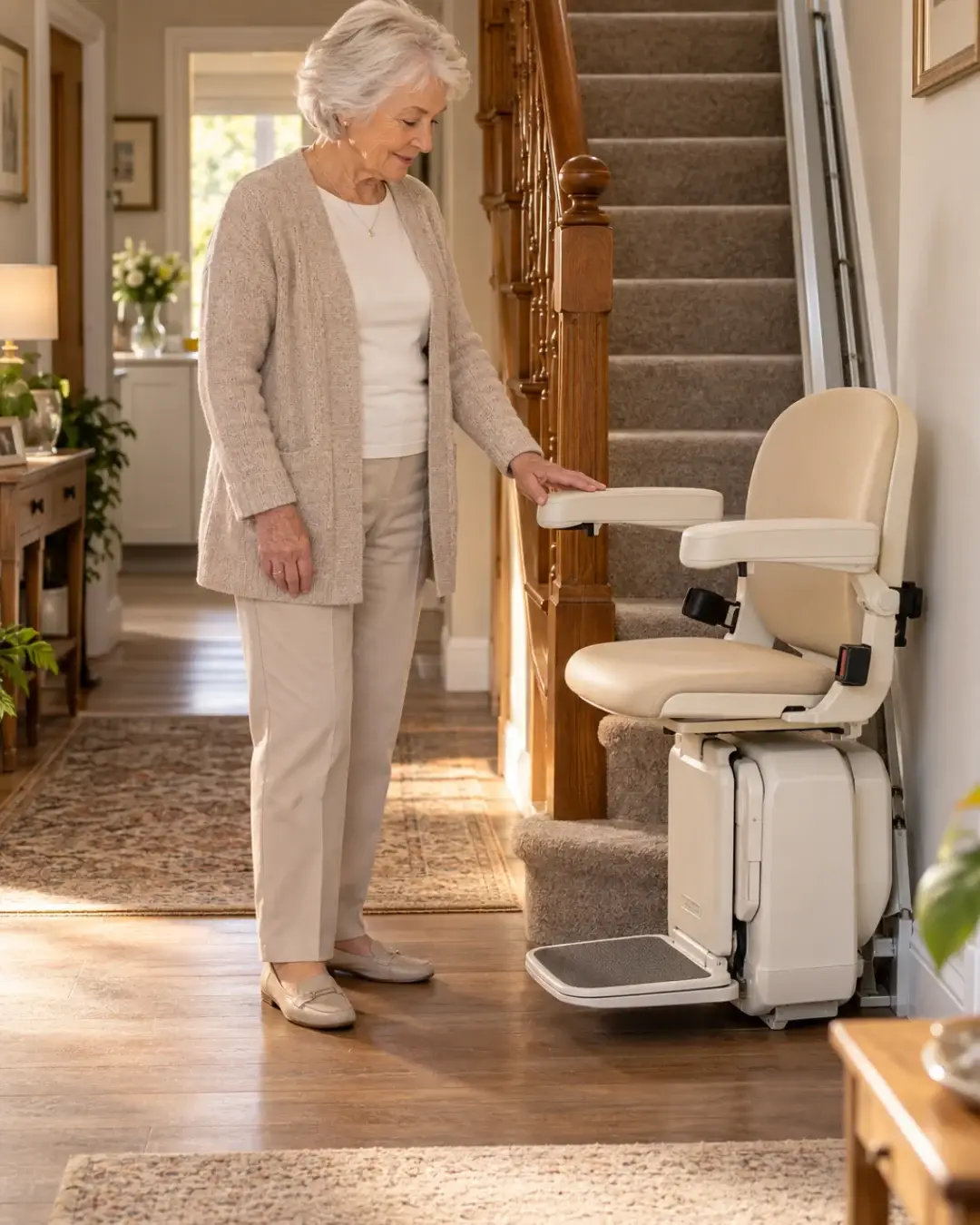
What happens at a stairlift home survey?
A survey connects the equipment with two things: the complete staircase and the person using it. The assessor needs to consider the rail route, available clearance, transfer areas and practical controls before recommending a model.
Expect a discussion of the journey you need to make, measurements of the stairs and landings, and questions about doors, power supply and planned changes. A straight flight and a winding staircase require different rail planning. Photographs help with preparation but do not replace that assessment.
The goal is an understandable proposal, not simply a tape-measure reading. Use our free home survey page to arrange the next step.
Show the assessor these five details
The whole route: include the last steps, corners and intermediate landings.
The doors: open nearby doors so their full swing can be considered.
Your routine: explain where you sit, stand and use a walking aid.
Other users: discuss the room others need to pass the parked chair.
Upcoming work: mention carpets, flooring, doors or structural changes before final measurement.
You do not need to take risks obtaining your own dimensions. Prepare a few accessible photographs if helpful and leave precise measuring to the visit. If an OT report is relevant to a grant or your access needs, tell the team in advance.
Prepare questions rather than a model choice
Ask about the recommended type, seat options, available new or reconditioned equipment and whether rental is relevant. Discuss the quotation inclusions, timing, warranty and servicing.
You do not need to take precision measurements beforehand. Clear photographs can help an initial enquiry, but the final assessment should establish what is needed.
What to have clear before placing an order
Keep the proposed model, rail route, features and parking positions with the written quotation. Check what preparation is needed, the total including VAT, payment stages, current supply time, fitting arrangements and cover.
If a particular feature solves a difficulty—such as a powered swivel for turning—make sure it is named in the specification. If a point remains uncertain, resolve it before accepting rather than assuming it will be added on fitting day.
The quote checklist helps compare proposals. The installation preparation guide is the next step once the arrangement is agreed.