

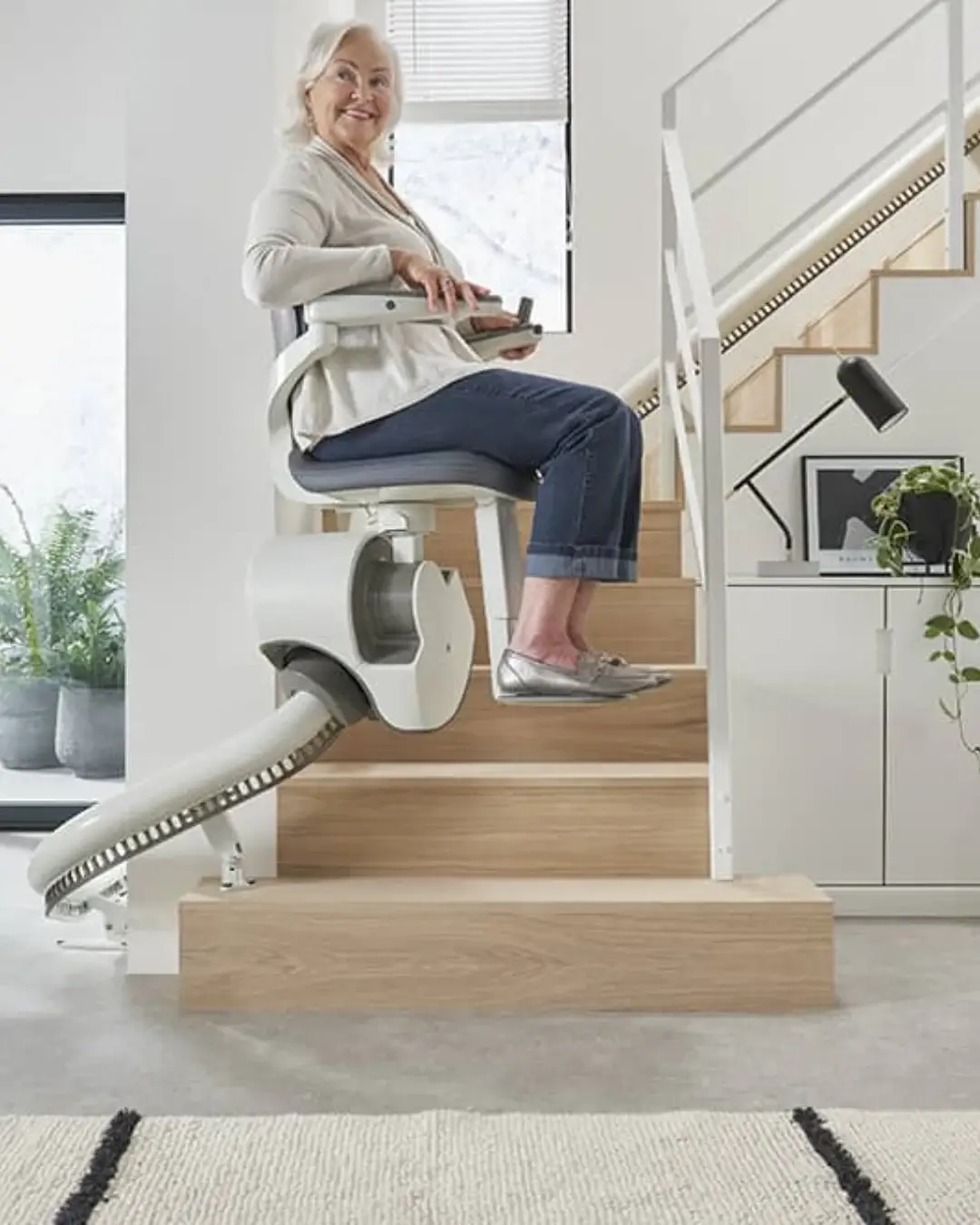
Straight or curved: follow the route, not the name
One unbroken flight: a straight rail is normally the first option to assess.
A quarter-turn: a rail must change direction around the corner.
A half landing or winding steps: assess a continuous curved route through the change in direction.
Several floors: each transition, stop and transfer needs individual planning.
A staircase can look straight from the hall yet turn at the top. Include the final steps and landing when describing it. Two separate straight lifts can mean an extra transfer at an intermediate landing; that may be impractical even if each individual flight accepts a straight rail.
Explore straight options and curved options after identifying the complete journey.
Do not overlook transfers
Two separate straight flights may appear to offer a simple arrangement, but transferring between lifts can be impractical for some people. The assessor needs to consider the user and the space, not just whether a rail fits on each flight.
Explain any difficulty standing, turning or moving across a landing. Where specialist assessment is appropriate, discuss that before deciding on the installation.
HomeGlide and Flow X: two different starting points
HomeGlide is designed for straight stairs. Flow X follows a planned rail route and can rotate its seat during travel, helping with turns and suitable restricted spaces.
A curved model can also be considered for some straight layouts, but that does not mean it is always the best or most economical solution. The survey should establish why a particular model is recommended for your route and seated clearance.
Mary’s Rathgar Flow X project is a useful example of a curved installation. Use it to understand the rail’s relationship with a real staircase, not to infer that the same dimensions or parking arrangement apply to yours.
Bring useful photographs
A view from the bottom, a view of the landing and a photograph of any turn can help the initial conversation. Keep doors and nearby obstructions visible. These photographs support preparation for a survey; they do not establish a final design or price.